🎵 Key Takeaway
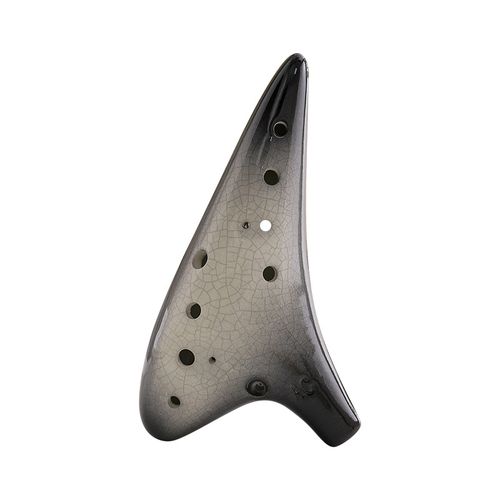
An ocarina is not a flute. A flute is an open pipe; an ocarina is a closed vessel. It works on the principle of a Helmholtz Resonator. This means the pitch doesn't depend on which hole you open, but on the total size of all open holes combined.
If you play the recorder or the silver flute, the ocarina will confuse you.
On a recorder, if you lift a finger at the bottom, the pitch goes up. If you skip a hole, the note sounds completely wrong. The order matters.
On an ocarina, you can often lift your left index finger OR your right index finger, and if the holes are the same size, you get the exact same note.
Why? Because the ocarina breaks the rules of normal wind instruments.
The "Pipe" vs. The "Jug"
A standard flute is a linear pipe. The air travels from one end to the other. When you open a hole, you are literally making the pipe shorter. A shorter pipe makes a higher sound.
An ocarina is a closed jug. The air goes in, spins around the chamber, and comes out the voicing. It doesn't travel in a line. It vibrates as one big ball of air.
What is a Helmholtz Resonator?
Have you ever blown air across the top of an empty glass bottle to make a whistling sound?
Congratulations, you just played a Helmholtz Resonator. That is exactly what an ocarina is.
The pitch of a glass bottle depends on two things:
- The volume of the air inside the bottle (how big the chamber is).
- The size of the opening.
If you drink half the water (making more room for air), the pitch drops. If you make the mouth of the bottle wider, the pitch goes up.
Why Ocarina Tuning is a Nightmare
Because the ocarina is a resonator, the location of the finger holes does not matter for the pitch. Only the total surface area of the open holes matters.
This means if an ocarina maker makes the Low C hole just a tiny bit too big, it ruins the pitch for every single note above it.
If they bake the clay and it shrinks by 2% in the kiln, the entire internal volume changes, and the whole instrument goes out of tune. This is why cheap, mass-produced ocarinas always sound terrible. Perfect tuning requires hand-carving and testing after firing.
Comparison: Linear Flute vs. Vessel Flute (Ocarina)
| Feature |
Linear Flute / Recorder |
Ocarina (Helmholtz) |
| Pitch Factor |
Length of the tube |
Internal volume + open hole area |
| Hole Position |
Critically important |
Does not affect pitch (only ergonomics) |
| Overblowing |
Jumps to the next octave easily |
Cannot jump octaves (Pitch just goes sharp) |
Summary
The next time you hold a perfectly tuned ceramic ocarina, respect the craftsmanship. You are holding a complex acoustic physics engine molded from mud.